The Treaties of 1851 and 1855
by Rachel Klade, Graduate Research Assistant (2022-2023)
Since time immemorial, the Kalapuyans in the west near the Willamette Valley and the Molallans in the east near the Cascade Mountains have called the North Santiam Canyon their territorial homelands. Their extensive and sophisticated use of the North Santiam Canyon is evident in the more than four hundred prehistoric sites and one hundred historic sites unearthed by archaeologists.
The Kalapuyans, who were also known as the “Santiam” by Euro-Americans after a local chief, established a seasonal pattern of hunting and agricultural practices in the North Santiam Canyon. In the colder winter months, they settled in lower-elevation villages, surviving off of preserved foods from the previous season’s harvest. In the spring, they moved away from their settlements to harvest local foods, such as acorns and the bulbs of camas plants. The summer months brought them to the higher-elevation areas of the North Santiam Canyon to hunt game and pick huckleberries. The Molallans developed similar cyclical patterns to the Santiam Kalapuyans, residing in villages closer to the Willamette Valley in the winter months before utilizing the abundant landscape of the North Santiam Canyon in the warmer months. Although these groups are unique in their cultures and languages, a relationship, although not always amicable, existed between them through marriages and slavery. Attracted to the abundance of fish, game, and harvestable food, the Kalapuyans and Molallans enjoyed the North Santiam Canyon as their homelands.
Euro-American encroachment of the Kalapuyan and Molallan homelands began in the early nineteenth century, but settler interaction was largely dictated and limited by Native choice. As Euro Americans established fur trading posts throughout the Willamette Valley, Native peoples declined to trade with them, preferring to trade with other Native peoples. Their commitment to their existing trade relations and seasonal lifestyle demonstrated their autonomy and persistence to the Euro-American newcomers. However, as more Euro Americans established households in the Willamette Valley and as diseases decimated the local Indigenous population, the Kalapuyans and Molallans’ autonomy was jeopardized. By the mid-1800s, both Native groups entered treaty negotiations with the US government.
On June 5, 1850, Congress passed an act that authorized the negotiation of treaties with Native nations in the Territory of Oregon and, in doing so, established the Willamette Valley Treaty Commission. The commission consisted of John P. Gaines, Governor of the Territory of Oregon; Anson Dart, Superintendent of Indian Affairs for the Territory of Oregon; Alonzo A. Skinner, the first judge in the Pacific Northwest, and Beverly S. Allen. By October 1850, the Office of Indian Affairs sent their directive to the Willamette Valley Treaty Commission: to meet with each tribe separately, to negotiate the purchase of their land, and to remove the tribes to eastern Oregon.
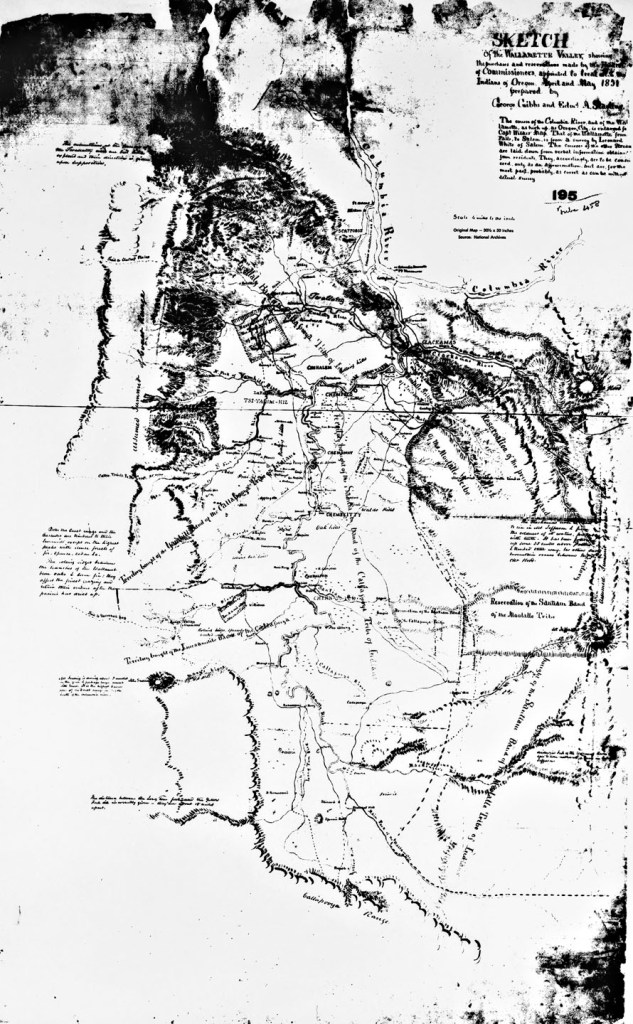
The commission first met with the Santiam Kalapuyans at Champoeg from April 11 to April 16, 1851. The historical records indicate how the Santiam Kalapuyans defended their right to remain in their homeland. On April 16, the Santiam Kalapuyans agreed to sell some of their land and establish a small reservation between the north and south fork of the Santiam River on their homelands. Similarly, the commission met with the Molallans from April 24 to May 7, 1851. On May 7, the Santiam Molallans negotiated the purchase of their land while insisting that they remain in the North Santiam Canyon.
Part of the agreement included a cash payment rather than a payment in Euro-American goods, which is yet another indication of the various ways the Kalapuyans and Molallans attempted to retain control over their interactions with Euro Americans. However, the treaties of 1851 were never ratified, despite being signed and authorized by agents of the federal government.
Encouraged by the growing voices of Euro-American squatters in the North Santiam Canyon as well as Oregon’s territorial governor Joseph Lane, treaty negotiations with the Kalapuyans and Molallans began again in 1855, but with a new fervor to remove all Native peoples from the Willamette Valley. Agents did not even meet with individual tribes but rather grouped all Indigenous nations, including every band of Kalapuyan and Molallan, together. In January 1855, Superintendent of Indian Affairs Joel Palmer negotiated a treaty where almost all of the Willamette Valley was ceded to the United States government The 1855 treaty took the North Santiam Canyon away from its Native keepers and removed the Santiam Kalapuyans and Molallans to a small reservation in the Grande Ronde Valley during the winter of 1855 and 1856.
While Native presence has since decreased in the North Santiam Canyon, their histories are still tied to the place. To the huckleberry patches where they once gathered berries, to the forested woods where they hunted game, and to the riverbeds where they dried their salmon, their stories are connected to the landscape.
Sources:
- Boxberger, Daniel. “Willamette Valley Treaty Commission.” Oregon Encyclopedia, Oregon Historical Society. Last updated August 1, 2023.
- Jette, Melinda. “Kalapuya Treaty of 1855.” Oregon Encyclopedia, Oregon Historical Society. Last updated March 17, 2022.
- Kelly, Cara McCulley. “Prehistoric Land-Use Patterns in the North Santiam Subbasin, On the Western Slopes of the Oregon Cascade Range,” MA Thesis. Oregon State University, 2002.
- Lewis, David. https://ndnhistoryresearch.com