Saving Cascadia State Park
By McKenna Schmitt, Graduate Research Assistant (2025-2026)
How Media Led the Defeat of the Cascadia Dam
Cascadia State Park is a distinctive cultural and ecological landscape along the South Santiam River in Oregon. It stood on the brink of inundation following the proposal of Cascadia Dam, a project designed by the U.S. Army Corps of Engineers during a period of expansive development in the Pacific Northwest. Authorized under the Flood Control Act of 1972, the proposal was planned as part of thirteen multipurpose projects intended for flood control, navigation, recreation, and hydropower. Cascadia Dam would have been the twelfth dam in the Willamette Valley Project.

The threat to Cascadia State Park sparked a multiyear campaign to protect the park and the surrounding community. Although the dam received formal authorization from Congress, it was never built. One key factor cited by a 1972 report by the U.S. Comptroller General of the United States was that the Corps overstated the project’s economic effectiveness by including flood control benefits not directly attributable to Cascadia. A second major reason was the significant concern and opposition expressed by the South Santiam community, particularly over the anticipated loss of Cascadia State Park. The local newspaper, the Albany Democrat-Herald, became the primary platform for voicing public opposition, portraying the dam as a threat to the community’s sense of identity and the ecological integrity of Cascadia State Park.
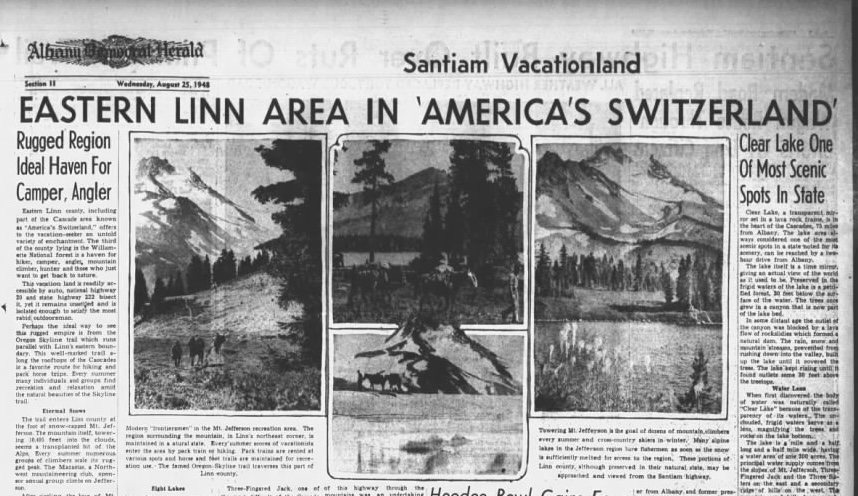
From the outset, the Albany Democrat-Herald localized the dam’s impact, emphasizing the cultural and ecological significance of Cascadia State Park. Coverage consistently highlighted the park as a space of communal belonging, memory, and identity. Articles from the late 1940s through the 1950s celebrated its scenic qualities while documenting family reunions, Garden Club events, church picnics, and informal retreats. One article described the area as “America’s Switzerland,” underscoring the park’s symbolic role in the region. These accounts presented the park not merely as a recreational space but as an ecosystem functioning as a home for residents and travelers alike.
Initial reporting on the dam echoed the Corps of Engineers’ framing, emphasizing hydropower and reduced floods that would help the local economy.1 Then, the Albany Democrat-Herald began highlighting the park’s imminent destruction. Headlines in 1958 warned the reservoir “will flood Cascadia State Park,” detailing impacts to picnic grounds, ranger stations, and tourist facilities.2 Maps published in 1959 made the threat spatially tangible, intensifying public concern and linking environmental loss to social loss.3
Letters to the editor became a primary means of articulating resistance. In 1959, a twelve-year-old wrote that Cascadia State Park was “the nicest spot for picnics [they] know of in Oregon…[where] many generations before them have enjoyed Cascadia State Park.”4 A 1961 contributor described Cascadia as “the park with irreplaceable mineral springs,” framing opposition in terms of ecological value.5 These letters emphasized that what residents sought to preserve was not merely land or facilities, but an ecosystem filled with social and emotional significance.
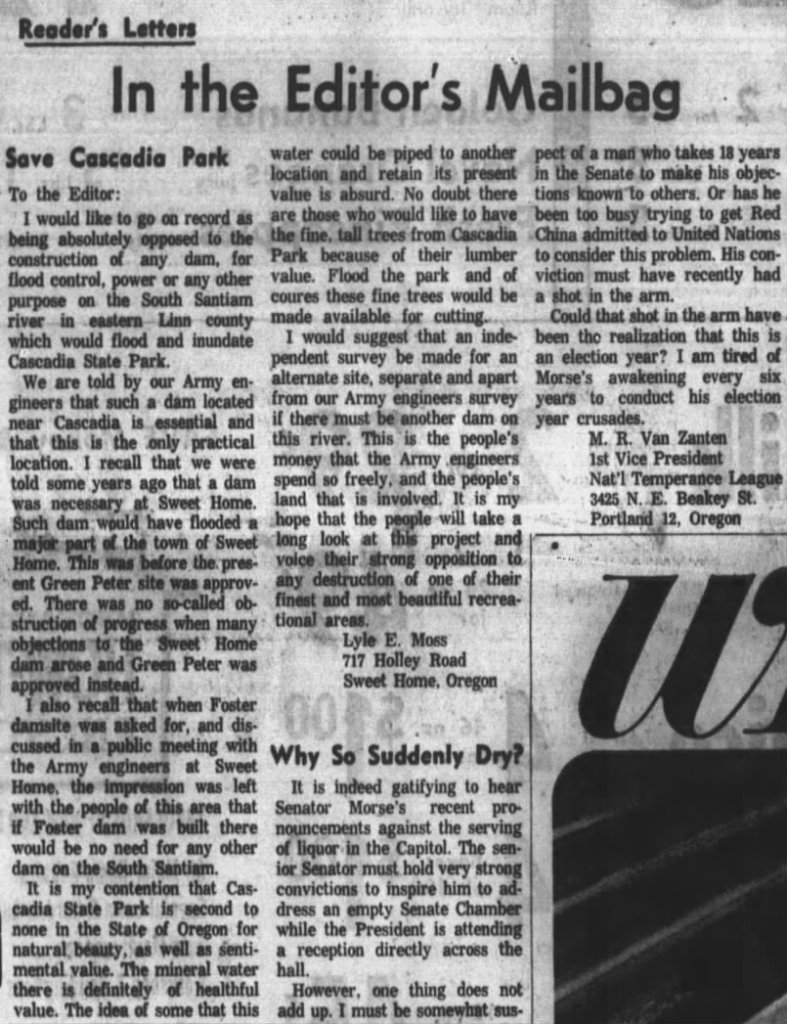
By 1962, the newspaper documented public meetings to spare the park, but reported that the Corps and the Linn County Chamber of Commerce stated “A dam site which would flood Cascadia State Park is the only economically feasible location” and “would cost too much…if the location is changed.”6 Sweet Home resident Lyle Moss publicly challenged this rationale, asserting the park “must be saved” and later appealed to Senator Wayne Morse, a story amplified in the letters to the editor section in the Albany Democrat-Herald.7
The newspaper articles reinforced the park’s ecological and cultural significance, celebrating its unique mineral springs, waterfalls, and role in local tourism. Articles depicted Cascadia as a landscape whose value was irreducible, both ecologically and socially. The combination of personal testimony and community memory provided a strong case against inundation. By the mid-1970s, stricter cost-benefit analysis reassessments and growing environmental scrutiny ended congressional financial support for Cascadia Dam. The park’s survival illustrates not only its valued community space but also of ecological importance and the effectiveness of media-mediated activism.
The Albany Democrat-Herald served as the interpretive bridge between residents and decision-makers. Coverage evolved from the potential destruction to advocacy-oriented journalism, highlighting letters to the editor, documenting local opposition, and emphasizing the park’s ecological, cultural, and social significance to the community. By framing the park as a shared sense of home, the newspaper shaped a public narrative that could not be ignored. Cascadia State Park endures today because the media amplified the community’s attachment to place, highlighting how local memory transformed into effective resistance.
Additional information:
- R. Hale, The Cascadia Story, http://www.oregonpioneers.com/Cascadia_Story.htm
- National Park Service, "Cascadia State Park history." https://npshistory.com/publications/oregon/history/sec5.htm
- "Cascadia Park was in peril." http://www.oregonpioneers.com/Cascadia_Story.htm