The Legal Basis for River Development in the Willamette Valley
by Nate Muir, Graduate Research Assistant (2025)
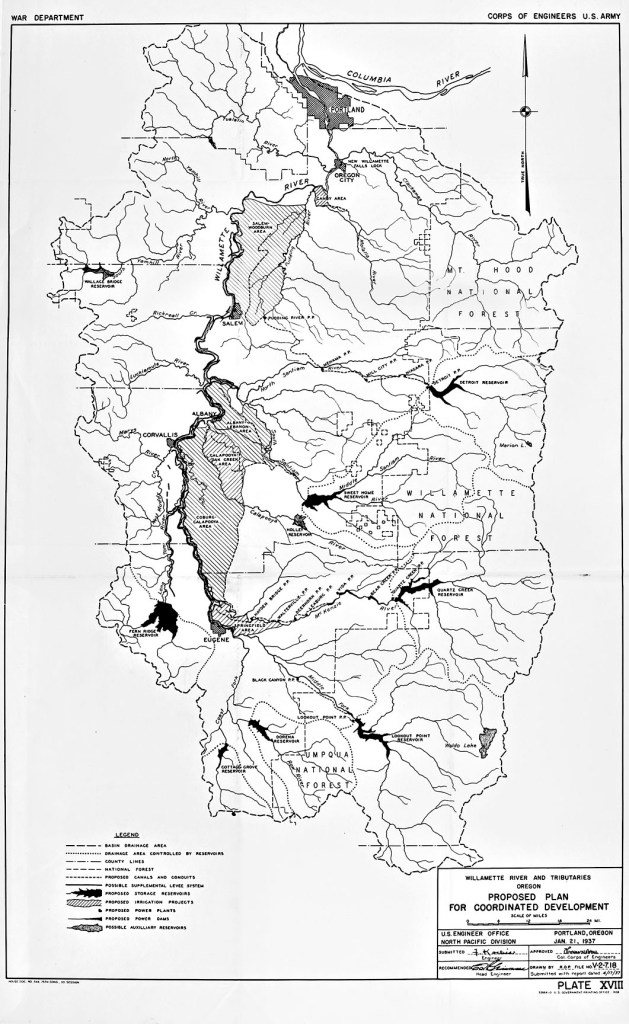
The 13 dams that make up the Willamette Valley Project (WVP) in Oregon represent immense effort: the many studies leading up to their construction, construction itself, and, perhaps even more impactful, their legal justifications. Each of these are decision points and call into question the shifting priorities of Congress, the Army Corps of Engineers, and local governments. With all that in mind, what is the legal rationale and process by which the United States Army Corps of Engineers (USACE), the Bureau of Reclamation, and other agencies, as well as private entities, such as Idaho Power, built such dam projects in the American West?
In the Willamette River Basin and along the Columbia River, it seemed that everyone could agree on the need for flood mitigation. Though there had been substantial flooding throughout the Pacific Northwest and throughout every era, the focus shifted to the Columbia and Willamette River Basins as population grew in the area over the course of the 19th and 20th centuries. Two of the most destructive floods occurred in 1861 and 1948. The 1861 flood is the largest on record; it swept away scores of buildings along the length of the Willamette River, including the entire town of Champoeg, and dozens of people died. Destructive floods such as this were the impetus for the US government to act. Gradually, the US government began taking on more and more responsibility for water resources throughout the country.
In 1925, Congress passed a Rivers and Harbors Act; as part of the Act, USACE was directed to determine the cost of surveying all of the natural waterways in the nation. Subsequent to that act, Congress passed the Rivers and Harbors Act of 1927, ordering USACE to actually perform several surveys and studies to ascertain the viability of water resource development along the Willamette and Columbia Rivers. The original goal set forth in the 1925 and 1927 Acts was to aid in navigation and develop irrigation reservoirs. In the reports for both rivers, presented to Congress in 1932 and 1933, respectively, USACE included wide-ranging development purposes as flood control, irrigation, navigation, and hydropower development. This policy shift resulted from the changing economic landscape, namely the Great Depression.
The 1927 Rivers and Harbors Act directed USACE to perform comprehensive studies, but the Act did not give them the power or prerogative to act on their findings. In 1936, Congress passed the first national Flood Control Act, which provided funding for additional surveys of the Willamette River Basin and set the wheels in motion for dam projects throughout the nation. In the intervening years between these Acts, the US and world writ large suffered from the Great Depression. As a response to the unprecedented nature of the Depression, Congress was willing to loosen its purse strings. The 1936 Act altered the justification for any flood control projects: if the benefits were projected to exceed the costs at all, even by just one dollar, then the appropriations would pass. This Act additionally asserted that “improvements of rivers and other waterways for flood control and allied purposes” would be under the purview of the War Department of the US government, rather than local entities. In the 1938 Flood Control Act, Congress approved the funding for and ordered USACE to begin planning and construction of the first seven dams of the eventual 13 dams in the Willamette Valley Project. The first dam completed was Fern Ridge; construction finished in 1942 on the Long Tom River, a tributary along the west side of the Willamette River Valley. The additional dams include Cottage Grove, Dorena, Detroit, Big Cliff, Dexter, and Lookout Point.
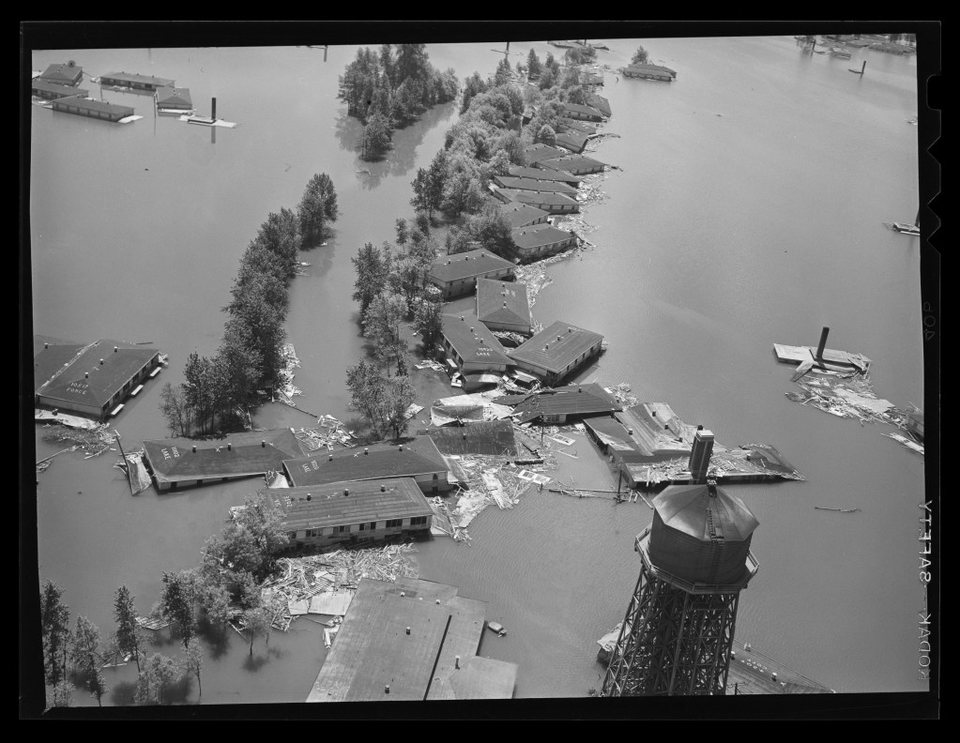
USACE’s mandate expanded once again with the Flood Control Act of 1950. The 1950 Flood Control Act came on the heels of the catastrophic 1948 Columbia River flood. Construction began on Vanport, Oregon, in 1942 as a housing project for war industry workers and swelled to a population of more than 40,000 during the war. The workers there primarily labored at the nearby shipyards in Portland, Oregon and Vancouver, Washington. In the years after the war, most residents stayed and continued to work in those same industries, taking part in the booming post-war economy. In 1948 the rising waters of the Columbia, fed by the Willamette, overcame the levees near Vanport and swept away the city, killing 15 people. Congress then overwhelmingly supported the expansion of the Willamette Valley Project. The Flood Control Act of 1950 added $14 million in floodwall and levee improvements near Portland, and authorized the construction of four additional dams along the Willamette and its tributaries: Hills Creek, Dexter, Fall Creek, and Holley. The Holley Dam on the Calapooia River was not built, however.
Congress doubled the appropriation for the Columbia River Basin dams, which included the Willamette Valley Project, jumping from $75 million to $150 million in an amendment to the Flood Control Act of 1950, passed in 1953. The Flood Control Act of 1954 accelerated the development of dams in the WVP and expanded their missions as well. At this point, Congress was interested in ensuring a cheap and plentiful supply of electricity for a variety of reasons, chief among them for national defense. The dams in the project that did not already have hydroelectric facilities would be evaluated for that purpose and, if possible, have them installed. The Flood Control Act of 1960 continued an aggressive policy of water resource development, authorizing the Foster Dam and approximately $17 million for its construction. Title III of that same legislation, referred to as the Land Acquisition Policy Act of 1960, handled a much wider subject, namely how the US Army Corps of Engineers would handle eminent domain for dam constructions and highways. The last of the WVP dams were authorized by the Flood Control Act of 1962, though several were not built.
The legal rationale for the Willamette Valley Project is essentially contained in the series of omnibus Flood Control Acts beginning in 1925 and ending with the 1962 appropriations. Through those acts, we see the decisions that Congress made as they responded to disaster situations that arose due to flooding in the Columbia and Willamette River Basins. The legal framework grew as Congress and the public felt a need to respond to flood events. Rapidly after the first appropriations, the dams become a beast of their own and take on a wider mandate than initially planned. The original intent as relatively straightforward navigation aids and flood mitigation grows into hydroelectric production, decreasing pollution, irrigation, and even recreation. Due to the gradual build up of the WVP and the length of time since the project’s inception, it can feel as though these dams have always been a feature of the landscape rather than a man-made structure. Revisiting the legal framework, the effort that went into their creation, can help to reframe their construction as decision points and responses to situations at a particular time that have had lasting impact.