Cold War in the West
by Jack Warner, Graduate Research Assistant (2022-2024)
The reverberations of the Cold War echoed worldwide, leaving no aspect of American society untouched, from government expenditure to environmental interventions. Domestically, this ideological standoff reshaped the very foundations of power, culture, and economics within the United States. The migration of military assets to the West became a novel and transformative event, especially when juxtaposed against the region's once-dominant agrarian and timber economies. The West, once perceived as a frontier overshadowed by the more established East, underwent a profound shift. It evolved into a focal point for scientific and military progress, drawing national attention and resources.
WWII and the Cold War saw the relocation of a staggering three million service men and women to the West, and the military-industrial complex followed suit. President Truman's decision to redirect federal resources from social welfare programs, as part of his "Fair Deal," towards the colossal development of military assets demanded swift infrastructural advancements. The unprecedented expansion of military bases during, and after WWII, reflected the fervent efforts of the United States government to bolster its network of military advancements, particularly in response to the looming threat posed by the Soviet Union. This expansion showcased the nation's commitment to fortifying its capabilities in the face of the Cold War's geopolitical challenges.
This development eventually landed in the Pacific Northwest, where industries were established to maintain the various military projects that required both soft and hard industry. As Oregon and Washington became centers of development for materials required for the construction of nuclear weapons, energy requirements arose as a potential bottleneck for their production. In the Tri-Cities region of Washington, a significant hub for nuclear material production emerged during the Cold War. The towns proudly displayed their importance through fashion, politics, and culture, deeply influencing local sentiments toward the West’s industrial development. Citizens were consistently reminded of the existential threat they faced and their crucial roles in supporting national defense. This evolution highlighted the West's increasing significance in Cold War defense strategies, leaving a lasting impact on the region's identity and commitment to national security. But this surge in demand raised concerns about potential energy bottlenecks impeding their output.
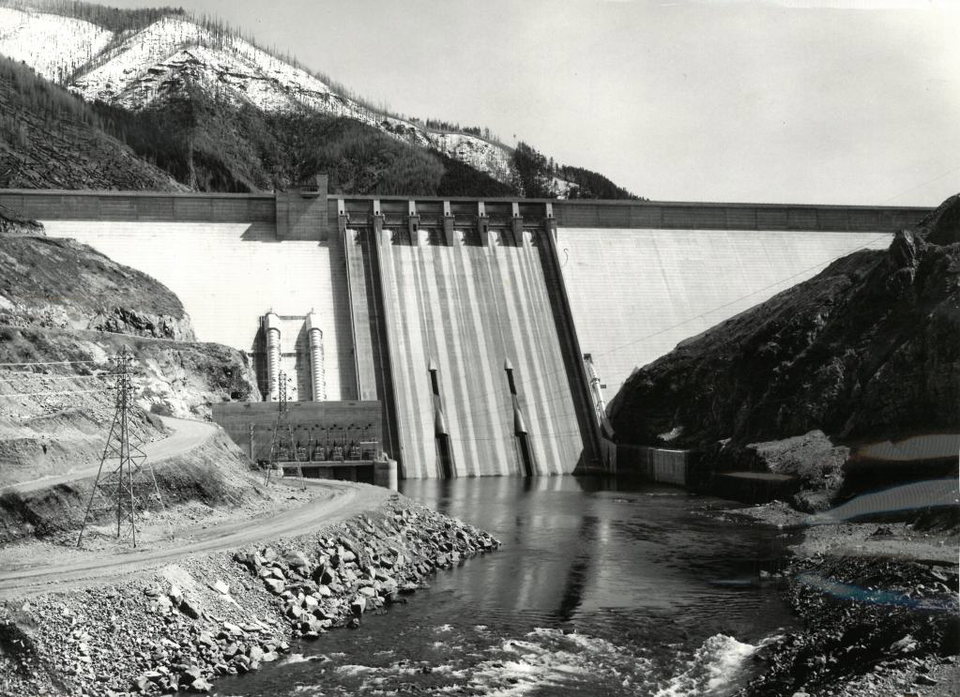
In response to the growing demand for hydroelectric power, the state resumed its previously planned dam development projects, originally conceived for flood control and irrigation purposes. As weapon and material production escalated in the early 1950s, hydroelectricity became a viable option for sustaining the military-industrial centers. Simultaneously, the urgent pleas for flood control in the Willamette Valley led to support for construction of dams. Instances of resolute resistance to dam construction were scarce, evident by the lack of outcries by the residents of the soon to be submerged towns. The Cold War played a role in this apparent apathy as residents of inundated towns saw it as their civil responsibility to not impede the advancement of the United States.
Sources:
- Dickstein, Morris. “After the Cold War: Culture as Politics, Politics as Culture.” Social Research 60, no. 3 (1993): 531–44.
- Lear, Linda J. “How the West Was Saved.” Edited by Richard Lowitt. Reviews in American History 13, no. 1 (1985): 107–12. https://doi.org/10.2307/2702019.
- Osgood, Kenneth A. “Hearts and Minds: The Unconventional Cold War.” Edited by Nancy Bernhard, Peter Grose, Scott Lucas, Gregory Mitrovich, Arch Puddington, and Frances Stonor Saunders. Journal of Cold War Studies 4, no. 2 (2002): 85–107.
- Rabasa, Angel, Cheryl Benard, Lowell H. Schwartz, and Peter Sickle. “The Cold War Experience.” In Building Moderate Muslim Networks, 7–34. RAND Corporation, 2007. https://www.jstor.org/stable/10.7249/mg574srf.9.
- Reinhardt, Bob H. “Drowned Towns in the Cold War West: Small Communities and Federal Water Projects.” Western Historical Quarterly 42, no. 2 (Summer 2011): 149–72. https://doi.org/10.2307/westhistquar.42.2.0149.
- Shaw, Tony. “The Politics of Cold War Culture.” Edited by Steve Nicholson, Christopher Mayhew, Paul Lashmar, James Oliver, Frances Stonor Saunders, Scott Lucas, Richard M. Fried, and James Chapman. Journal of Cold War Studies 3, no. 3 (2001): 59–76.
- The Cold War American West, 1945-1989. Albuquerque : University of New Mexico Press, 1998.