Big Personalities
by Rachel Klade, Graduate Research Assistant (2022-2023)
Detroit’s original townsite began as a work camp for the Oregon Pacific Railroad in 1889, and although the railroad tracks stopped only a few miles east of town due to the company’s bankruptcy in 1890, Detroit attracted enough settlers that warranted a post office in 1891. Andrew B. Hammond later bought the Oregon Pacific Railroad in 1895, finished the line through Detroit, and established numerous logging camps in the area. With a new level of accessibility and more job opportunities, Detroit grew in number. From the time Detroit was founded in the late nineteenth century to when it was inundated in 1953 by the construction of Detroit Dam, the town and surrounding area was a place that was lived in and loved by many people. From the Santiam Kalapuyans and Molallans to John Outerson to Hilma “Ma” Dickie to Mrs. Mabel Moore, these people contributed to the character of Detroit.
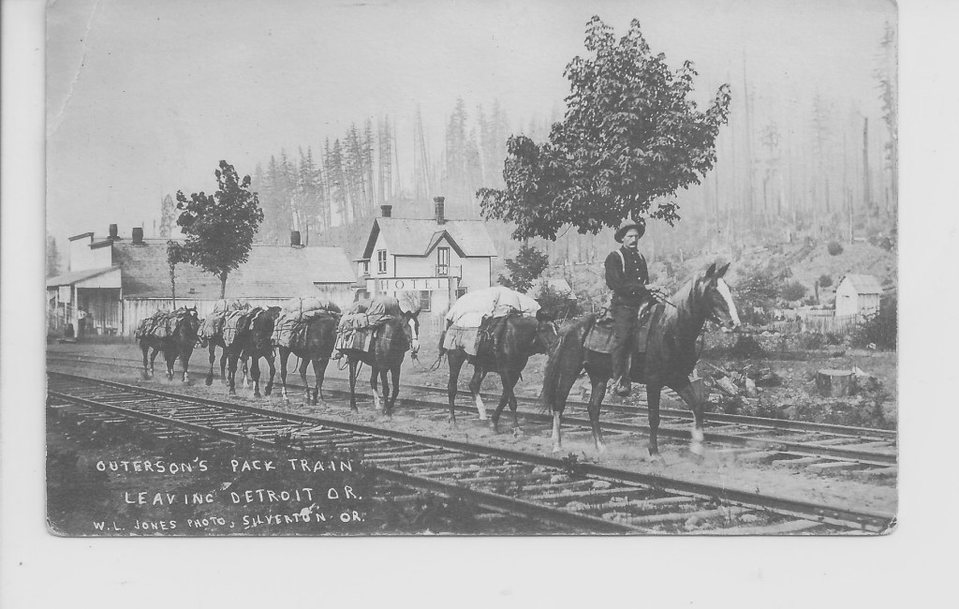
Outerson's Pack Train, ca. 1913. Photo courtesy North Santiam Historical Society.
John Outerson
Born in Scotland in November 1853, John Outerson immigrated to the United States in 1886.[1] Arriving on the steamship Austrian in Boston harbor, John went to live in Mackinaw City, Michigan, when he first arrived.[2]
John was one of the earliest settlers in Detroit, Oregon, and it is said by some that Detroit was renamed from its original name of “Coe” due to several immigrants from Michigan settling in the area. John established a store in the early 1890s, which served both residents and visitors. He wanted to showcase and share the natural beauty of the Mount Jefferson Primitive Area with more people, so he began renting pack trains to mountain climbers and other sportsmen. [3] Some even remembered John’s speed and skill in loading pack animals as bordering “upon magical.”[4]
In 1914, the U.S. Forest Service (USFS) praised John for his work leading fire patrol efforts. In addition to supplying campers, hunters, and other visitors to the North Santiam Canyon, John had his packers, J.L Cooper and two assistants, traverse the backcountry to look for signs of smoke and fire. Not only did this prove to be an efficient method of fire patrol, but John also asked the USFS for literature on fire safety so that he could educate all the visitors he served.[5] As he invited more people to experience the abundant landscape of the North Santiam Canyon and worked to preserve it from wildfires, John clearly enjoyed and wanted to others to enjoy the area he called home. Although he died on September 12, 1917, his memory is preserved in Outerson Mountain, which was renamed after him.[6]
[1] "United States Census, 1900", database with images, FamilySearch (https://www.familysearch.org/ark:/61903/1:1:MSDN-KKG : 11 March 2022), John Outerson in entry for Jack Hamlyn, 1900.
[2] “Massachusetts, Boston Passenger Lists, 1820-1891,” database with images, Family Search (https://familysearch.org/ark:/61903/3:1:939K-YCS5-Z?cc=1860873&WC=m612YWG%3A168071301 : 26 August 2019), 100 – March 1-May 15, 1886 > image 529 of 576: citing NARA microfilm publication M277 (Washington, D.C.: National Archives and Records Administration, n.d.).
[3] Compiled by Workers of the Writers’ program of the Works Progress Administration in the State of Oregon, Oregon, End of the Trail (Portland: Binsfords & Mort, 1951), 476.
[4] Letter to the North Santiam Historical Society about their 2004 newsletter, January, 8, 2004.
[5] “Forest Service Praises Work of Fire Patrol,” The Daily Capitol Journal (Salem), August 19, 1914.
[6] Lewis A. McArthur, “Oregon Geographic Names,” Oregon Historical Quarterly 28, no. 3 (September 1927), 298.
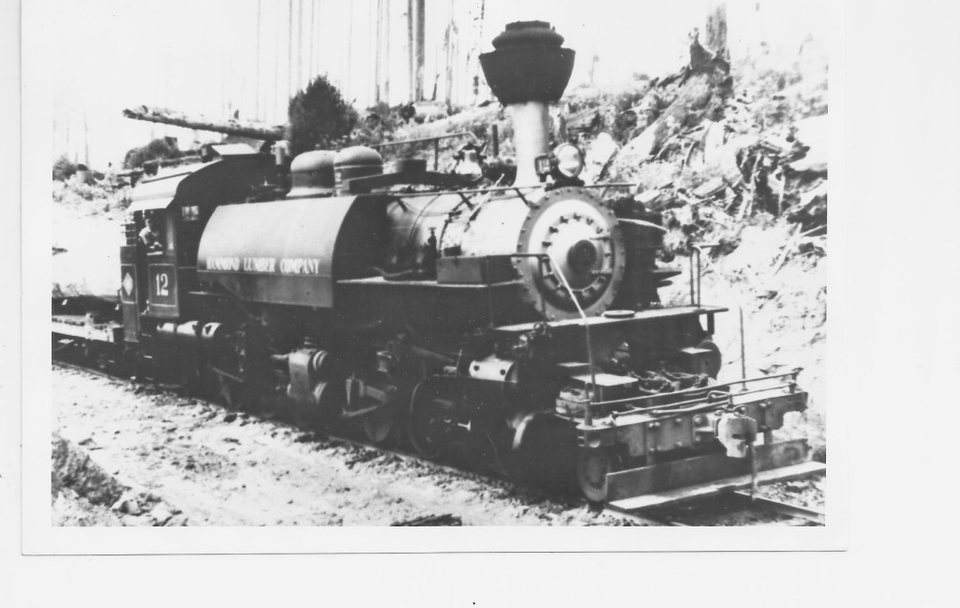
Hammond Lumber Company engine, ca. 1900. Photo courtesy North Santiam Historical Society.
Grace Ruth Smith
Born in 1905 in Albany since there were no doctors in Detroit, Grace Ruth Smith remembers Detroit as a lovely place to grow up. Her father and grandfather originally settled in the town of Niagara, about thirteen miles west of Detroit, before relocating to Detroit and buying a mill of their own. As Andrew B. Hammond established numerous logging camps in the North Santiam Canyon during the 1890s, logging became an important industry, bringing many new residents to Detroit. The arrival of the daily logging trains was the social occasion of the day. The engine would be driven onto the turn table, and all the men in town would use long wooden handles to turn the locomotive around. According to Grace, the “railroad was the only connection to the outside world.”[1]
[1] Grace Ruth Smith, Diary, Oregon Historical Society, MSS 1509, Diaries and Reminiscences.
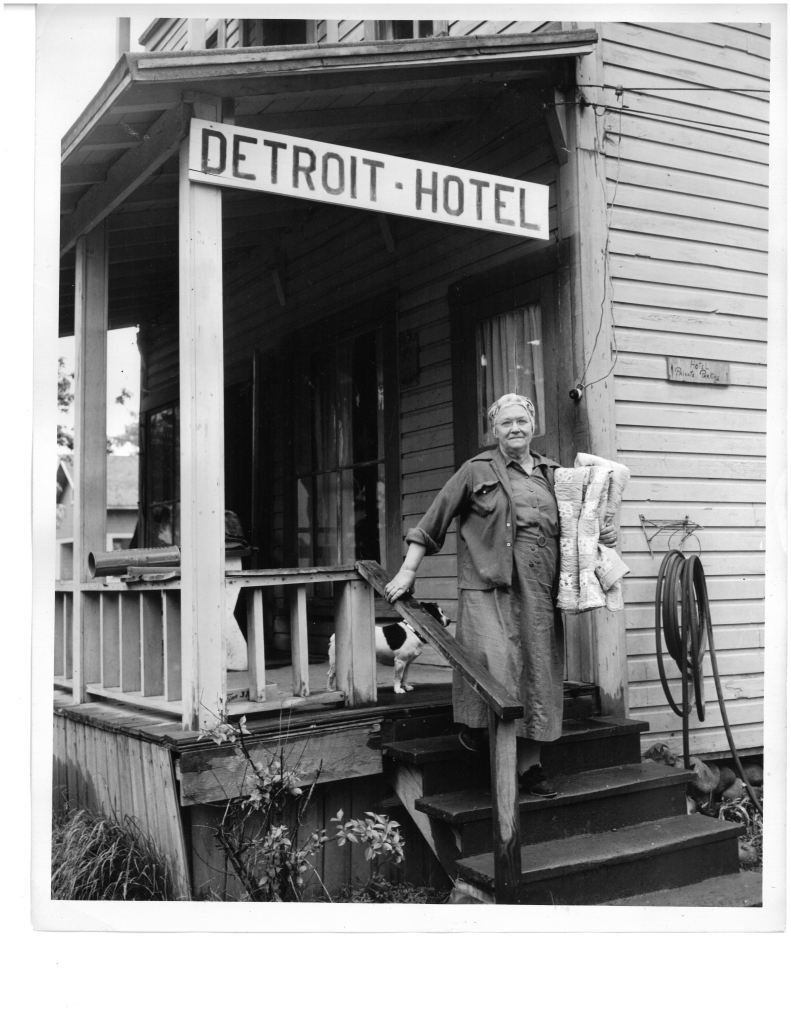
Hilma "Ma" Dickie, 21 May 1952. Photo courtesy Oregon Historical Society.
Hilma “Ma” Dickie
Hilma E. Dickie, otherwise known as “Ma,” was born in Sweden in 1890 and later immigrated to the United States at the age of eleven in 1901.[1] Ma Dickie owned Detroit Hotel, a fourteen-room hotel that she ran for more than 20 years, but the construction of the dam forced her to abandon her business. At first, the U.S. Corps attempted to persuade residents with monetary encouragement, but as Ma Dickie said, “the government didn’t give us too much for what we have.”[2] Many residents were unwilling to leave—they were connected to the place. During a public meeting in June 1949, Ora Leis asked the U.S. Army Corp of Engineers’ Chief of Real Estate “if there is any possible site that the people could have…People don’t want to leave here.”[3] The Chief of Real Estate dismissed Leis’s request, stating that “that’s the way it is.” Although Ma Dickie’s hotel was eventually burned in preparation for the rising waters, many residents fought for “new” Detroit.
[1] “United States Census, 1930,” database with images, FamilySearch (https://familysearch.org/ark:/61903/3:1:33SQ-GRC8-9H4?cc=1810731&wc=QZF7-9W4%3A648804701%2C646605702%2C649754701%2C1589282363 : 8 December 2015), Oregon > Marion > Breitenbush. > ED 5 > image 2 of 6; citing NARA microfilm publication T626 (Washington D.C.: National Archives and Records Administration, 2002).
[2] “Passing of Detroit Brings Both Cheers and Moans,” Oregonian (Portland), May 21, 1952.
[3] “Detroit Order OK’d,” Mill City Enterprise, July 21, 1949.
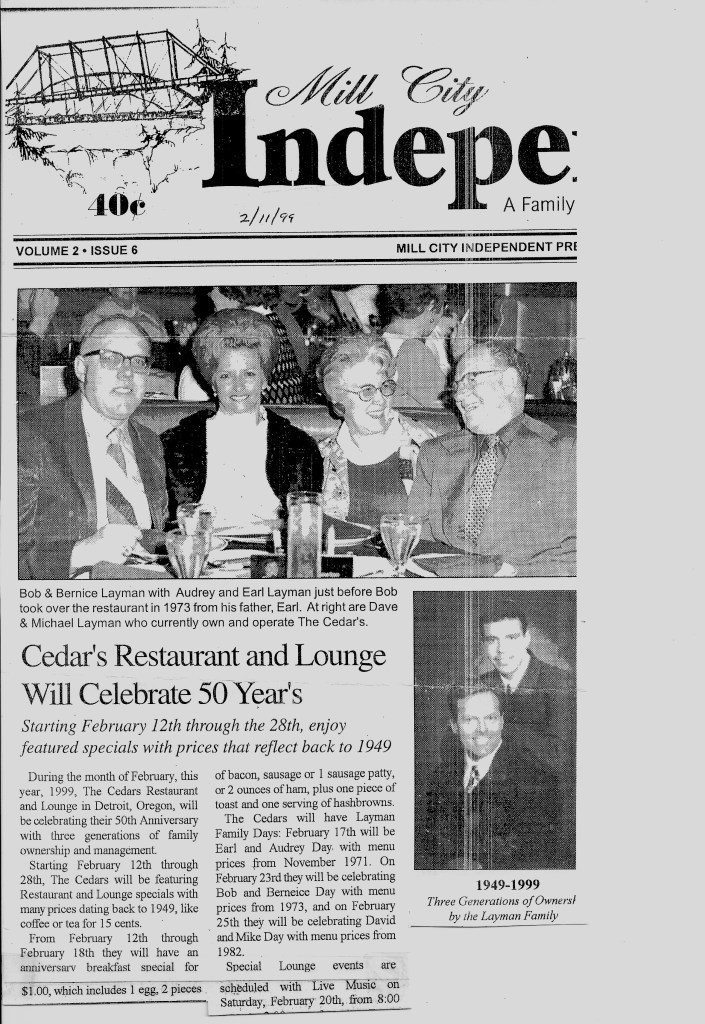
50th Anniversary of Cedar's Restaurant, Mill City Independent, 11 Feb 1999.
Earl and Audrey Layman
Earl and Audrey Layman relocated to Old Detroit from Toledo, Oregon, in 1949 on the eve of Detroit Dam’s construction. Prior to their arrival, they purchased a portion of the Cedar Tavern. After operating their new business for only a short time, they discovered that the number of workers for the Detroit Dam Project was cut by 60%, meaning their clientele also decreased. To make ends meet, Earl became a foreman for Penrod Construction Company, clearing trees in the basin behind Detroit Dam to clear the way for the future reservoir. Audrey worked tirelessly at the tavern, putting in about ninety hours a week. As residents had to abandon Old Detroit, Earl and Audrey purchased one of their partner’s portions of the restaurant and planned with their other partners to move Cedar Tavern to the new townsite in 1951. During the Fall of 1951, they moved the building four miles from its original location and spent the winter remodeling the restaurant in preparation for their grand opening on May 10, 1952. The restaurant was the Layman’s legacy. Earl and Audrey passed it down to their son and daughter-in-law, Bob and Berneice Layman, who operated Cedar Tavern until the mid-1980s when their son, David, took over management.[1]
“The friendly atmosphere and ample parking area are just two of many reasons The Cedars has traditionally been the most stable of restaurants in the entire Canyon.”[2]
[1] “Cedar Tavern & Cedars Restaurant and Lounge, 1949-199/Three Generations of Ownership by the Layman Family,” [ca. 1999], folder Detroit, North Santiam Historical Society, Mill City, OR.
[2] “The Santiam Canyon’s Guide to Quality Dining,” Catch 22, 8. Willamette Heritage Center, Salem, OR.
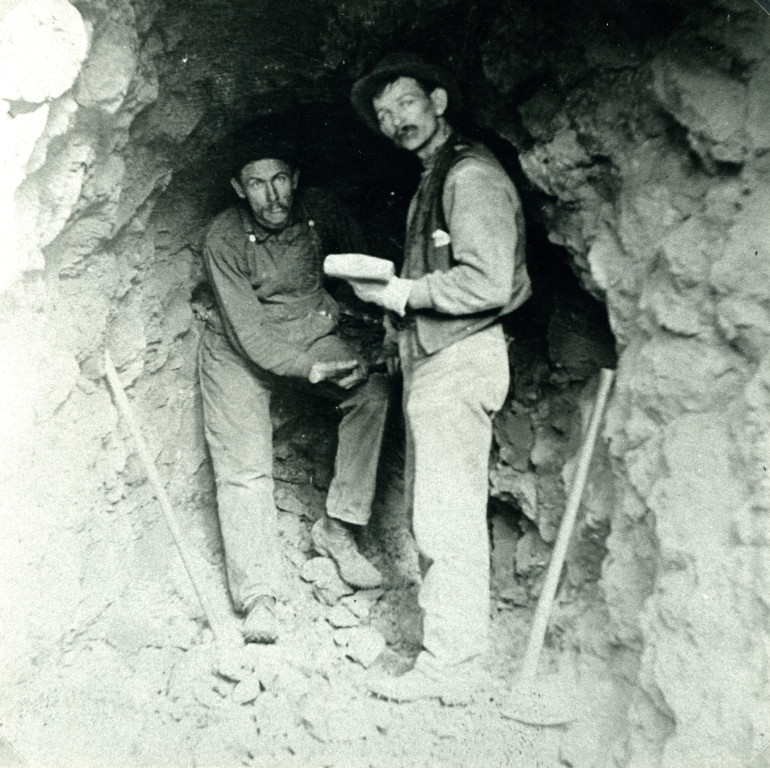
OSU Special Collections & Archives Research Center, Oregon State University. "William J. Smith and Fred Stahlman at the Greenhorn Mt. Mine, Detroit, Oregon, 1905-1913" Oregon Digital. Accessed 2023-11-22. https://oregondigital.org/concern/images/df66vc73v
Stahlman Family
Settling in Detroit in the late 1800s, the Stahlman family boasts a multi-generational legacy in the North Santiam Canyon. In 1894, Frederick Warren Stahlman, born in Coe, Michigan, in 1868, married Fanny Viola Smith, born in Everett Township, Michigan, in 1873.[1] By 1900, they were living in Detroit, where their first three children were born. Fred and Fanny went on to have a total of eight children, but one of their first children died during infancy.
Detroit attracted enough settlers that warranted a post office in 1891. Sometime in the late 1800s and early 1900s, Fanny was postmistress, and Fred took over the position from 1903 to 1906.[2]
Fred worked as a miner on a tunnel on Greenhorn Mountain with William John Smith, and later managed his mill when William went to get married East. [3] The newly formed Forest Service appointed Fred as the first District Ranger in the Detroit area on April 16, 1906, and he served in this position until 1911.[4] A few miles south of Old Detroit, a small mountain was renamed after Fred. The Forest Service built a lookout in 1946, which Fred’s grandson, Jim Stahlman, later worked at as a fire lookout.[5]
Jim Stahlman, who spent his teenage years living and working in Old Detroit, created a detailed map of Old Detroit from memory.
[1] Frederick Stalhman in household of Aaron Stalhman, “United States Census, 1870,” FamilySearch, https://ancestors.familysearch.org/en/KHLM-8X8/frederick-warren-stahlman-1869-1939.; Fannie V. Smith in household of James M Smith, “United States Census, 1880” Family Search, https://ancestors.familysearch.org/en/KC2Z-RVB/fanny-viola-smith-1873-1945.; “United States Census, 1900,” FamilySearch, https://ancestors.familysearch.org/en/KHLM-8X8/frederick-warren-stahlman-1869-1939.
[2] Boots Champion, "'Mails and Females' Major Attractions on Early Detroit," Oregon Statesman (Salem), March 9, 1968.
[3]Grace Ruth Smith, Diary, Oregon Historical Society, MSS 1509, Diaries and Reminiscences.
[4] Champion, "'Mails and Females' Major Attractions on Early Detroit.”
[5] Connie Stahlman, “Stahlman Point,” Oregon Hikers, https://www.oregonhikers.org/field_guide/Stahlman_Point.